
Guide
Run a local LLM in your Foundry game.
Familiar's chat can talk to a model running on your own PC instead of a cloud provider. Point the Local AI tab at Ollama, LM Studio, llama.cpp, or a LiteLLM gateway, flip one switch, and your table runs on a model you host yourself. Your world never leaves that machine, and no provider bills you per token. The trade is speed. Without a discrete GPU, replies come back in minutes rather than seconds.
The runner, the network, and the bill
A runner is an app that serves a model on your machine. You install one, load a model into it, and Familiar sends your messages there instead of to a hosted provider. Your prompts, the world context that travels with them, and every reply all stay on your own hardware.
A few requests still reach the network when a world loads, and not one of them carries your game. Familiar refreshes the model list so the dropdowns stay current, and it checks your licence with Polar. That call sends the key and the product id, nothing else. The licence answer is cached for a week, so an offline evening plays straight through.
No provider key, and no per-token bill. That is not the same as free. You pay in the graphics card you already own and the power it draws while it thinks, and if you own the wrong hardware you pay in waiting.
Local setups vary far more than hosted ones, so this is where the rough edges surface first. If yours bites in a way this guide did not warn you about, the Discord is where I hear about it.
What it asks of your setup
Two things decide whether local play feels good: the model you load and the hardware under it. Check both before you download eight gigabytes of weights.
The model has to be able to call tools. Familiar works by calling them: rolling the dice, applying a condition, opening the right journal page. Hand the job to a model that cannot, and it will narrate an attack that never happened, which is worse than a refusal, because it looks like it worked. Tool skill collapses below about 9B and stays unreliable up to 14B, so the floor is a tool-trained model of 14B or more, at Q4_K_M quantisation or better.
That floor buys you tool calls, not fights. Switching combat on roughly triples the tool definitions the model has to hold, and turns a single turn into a chain of calls. The comfortable sizes for combat start well above the floor.
Hardware sets the speed. The request Familiar sends carries the core tool definitions plus your world context, roughly 8,000 to 10,000 tokens before you have typed a word. A 24 GB card works through that in seconds. On a CPU-only machine we measured 5 to 10 minutes per turn, and a whole exchange is capped at fifteen minutes, so a multi-step turn does not fit on CPU at all.
- A tool-trained model, 14B or larger, at Q4_K_M or better. Your runner can often tell you before you load it, and a non-thinking variant is the right pick when speed matters.
- For combat, 27B to 32B dense, or 30B to 35B active on a mixture-of-experts model, which wants about 24 GB of video memory. An 8 GB card holds about an 8B model, under the floor: single tool calls land, a fight is marginal at best.
- The runner set to a context window of at least 16K, or 32K if you run combat through the chat.
- A way of reaching Foundry that allows the call. The desktop app or a localhost tab is always fine; hosted games and Safari have limits, covered under Where your browser allows this below.
Familiar waits up to five minutes for the first token from a local server, where a hosted provider gets two. That is headroom for slow hardware, not a target.
Pick a runner
Familiar ships a preset for four runners, and each one leaves you a single setting to change on your side. Keep the runner and the model apart while you set this up: the runner is the plumbing, the model you load into it is the brain.
| Runner | Base URL | What you set |
|---|---|---|
| Ollama | http://localhost:11434/v1 | The context window, before your first message |
| LM Studio | http://localhost:1234/v1 | Enable CORS, then Context Length when you load the model |
| llama.cpp | http://localhost:8080/v1 | Nothing on current builds. Older ones need the jinja chat template for tool calls |
| LiteLLM | http://localhost:4000/v1 | The master key, and which origins the gateway accepts |
Ollama is the shortest path of the four. LiteLLM is the one to reach for when several backends sit behind one address, or when the runner itself should not face the browser. Point LiteLLM at a hosted model and you are back to a provider key and a token bill: the gateway is local, the model is not.
Point Familiar at your server
Everything for this path lives on one settings tab. In Foundry, open Module Settings, then Familiar, then Configure AI, and pick the Local AI tab at the end of the list.
Four fields, one switch, one test. You do this once.
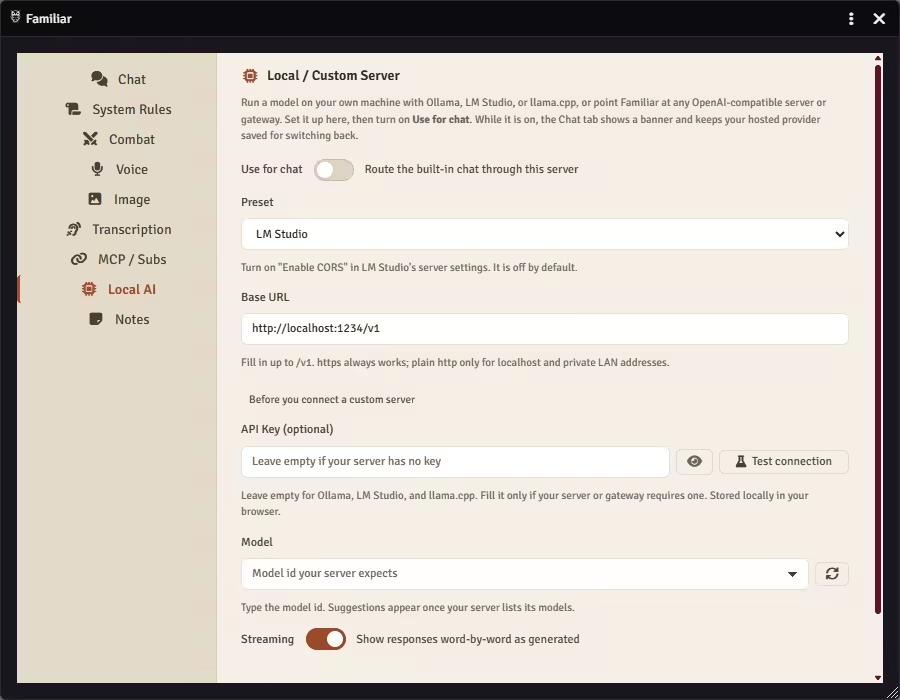
Pick your runner
The Preset dropdown lists Ollama, LM Studio, llama.cpp, and LiteLLM, plus an Other entry for anything else that speaks the OpenAI chat API.
Check the Base URL
The preset fills it in up to /v1, and Familiar appends the rest itself. If your runner reported a different port when it started, correct it here.
Leave the API key empty
A local runner normally wants no key at all. A gateway does: paste the key it expects, such as your LiteLLM master key.
Type the model id
Type the exact id your server serves. Once the server answers, the field suggests what it found, but it is required either way.
Flip Use for chat on
This is the switch that moves the built-in chat over to your server, and it is the only route there: the provider list on the Chat tab does not offer your server, and neither does asking your AI to change provider. The hosted provider on the Chat tab stays saved, so going back later is one flip.
Hit Test connection
It sends a small real message to your server, so a connected result means the whole path works and not merely that the port is open.
Then open the chat and ask it to roll a d20. If the roll lands in Foundry's chat log, your model is calling tools and you are done.
Ollama: raise the context window first
Ollama on the same machine is close to zero configuration. Its own defaults already accept a Foundry page served from localhost, so there is nothing to allow and no key to set.
Skipping one setting is the likeliest reason a local setup disappoints: Ollama ignores the context size a client asks for, loads at 4K, and then truncates in silence. No error appears. The model forgets the tool definitions and half the conversation, and starts describing actions instead of taking them.
Set it in the environment that starts Ollama, restart Ollama, and check the result with ollama ps. The CONTEXT column reports what the loaded model got, which is the only number worth trusting here.
OLLAMA_CONTEXT_LENGTH=32768
ollama ps
LM Studio: turn CORS on before anything else
LM Studio serves the model from its Developer view, and one of its switches is off by default: Enable CORS. Without it the browser blocks the request before it leaves the page, and Familiar reports that it could not connect to the AI provider. Nothing ever reached LM Studio.
LM Studio warns you when you turn CORS on, and it is right to: with it on, any website your browser visits can call your server, so stop the server when you are not playing.
The context length is the second step, and LM Studio wants it set as you load the model, not after. Drag Context Length to at least 16,384 before you press Load, or 32,768 if you plan to run combat through the chat. The default is 4,096 or 8,192. Both fill up before your first message is read.
- Look for the tool-use badge, a small hammer, beside the loaded model. No hammer means it cannot call Familiar's tools, however well it writes.
Where your browser allows this
The chat calls your server straight from the Foundry page. That is what keeps this path simple, with no bridge and nothing in the middle. It also hands the decision to your browser: what is allowed depends on how you reach Foundry, and the grid below is its ruling.
Most setups clear this without a thought: the desktop app and a localhost tab are both fine. The rules only bite once Foundry and the model sit on different machines, or once https is in the path.
Familiar supports the field, not your backend. The Local AI tab and the connection it makes are ours to fix; the server, the model, and the machine under them are yours. If a model misbehaves through your runner but behaves elsewhere, start there.
| How you run Foundry | Does it work? |
|---|---|
| The desktop app, or a browser tab on localhost, with the runner on the same machine | Yes. Nothing to configure and no prompt. |
| Hosted Foundry over https, The Forge for example, with the runner on your own PC | Yes, after one prompt. Chrome asks once for access to your local network, and granting it sticks. Your runner also has to accept your game's address, which on Ollama is the OLLAMA_ORIGINS setting. |
| Hosted Foundry over https, with the runner on a second PC reached by its LAN address | No. An https page cannot make a plain http call to a LAN address, so the browser blocks it as mixed content. Give that server https, front it with a gateway, or move it to the machine you play on. |
| A hosted game opened in Safari | No. Safari blocks a hosted game from reaching a local server. Use Chrome, Edge, or Firefox, or play in the desktop app. |
The pattern behind the grid: keep the browser and the model server on one machine, and reach Foundry on localhost where you can. Open your own game by its LAN address instead and it becomes a new origin to your runner, needing the same allowance the hosted row above describes.
When it does not work
Four failures cover almost everything people hit on a local setup, and each one points somewhere specific. Work down the table before you change the model.
| What you see | What it means | What to change |
|---|---|---|
| Failed to connect to AI provider, the instant you send | The request never left the browser | CORS is off in LM Studio, the server is not running, or the port in the Base URL is wrong. |
| An error about the available context size as soon as you send | The window is too small for the tool definitions | Reload the model at the size under What it asks of your setup. On Ollama, set it in the environment and restart. |
| It describes an action, but nothing happens in Foundry | It is not calling tools | Check the model is tool-trained and big enough, then update your runner. If calls arrive but look garbled, turn Streaming off on the Local AI tab to isolate it. |
| The first reply takes minutes, or Familiar reports the endpoint too slow | Hardware, not setup | No setting fixes this one. A discrete GPU, a smaller model, or a hosted provider for the nights that lean on tools. |
Expect one more thing rather than fixing it: a model that streams its reasoning has that rendered in the collapsible Thinking view instead of the reply, and the thinking still costs real time on slow hardware.
A speech server on the same machine
The Voice tab has the same idea for speech. Pick Custom TTS (OpenAI-compatible) as a voice provider and point it at any server that answers OpenAI's speech call, a self-hosted voice cloner or a local engine with that front on it, with the key left empty when the server wants none. An address on your own machine or your home network is fine, 127.0.0.1 or a 192.168 one. The guard that stops a provider redirecting Familiar to an internal address makes one exception, the address you typed into this row, and holds everywhere else. The browser rules above apply unchanged, since the speech call is browser-direct as well.
Open weights without the graphics card
Plenty of people reach for local because they want open weights and no bill, and local is only one way to get both. The same open models run on hosted services at full precision, over https, on someone else's GPU. Groq, Cerebras, DeepSeek, and OpenRouter are already in the provider list on the Chat tab, several with a free tier. None of them need CORS, a graphics card, or a context setting.
Local earns its place on the other axis. Your world stays where it is, and the evening plays on with the network unplugged. Pick it for that.
Try it on one scene
Load a model, point the Local AI tab at it, and run one short scene: a conversation, a skill check, a single fight. That is enough to tell you whether your machine is up for a whole session.
If it drags, you have spent a download and learned something concrete about your hardware. If it flies, the whole table is yours.
More in Connect your assistant
Claude in Foundry: Desktop or Code
NewAnthropic builds both clients, so no agent app sits in the path. Desktop and Code differ in how you add each one, how many tools each carries, and whether a fetched picture ever reaches your screen.
ChatGPT in Foundry via Codex
NewThe Chat tab is not the piece that connects. The Codex tab in the ChatGPT app is, on every plan including Free, and so is Codex CLI from Plus upward: OpenAI's own agent either way. Both read the same config file.
Gemini in Foundry via Antigravity
NewAntigravity is Google's agent, and it is what reaches your Foundry game. Any Google account gets you in, including a free one. Or skip the agent altogether: a Google API key, pasted into Familiar's own chat window.
Grok in Foundry via Grok Build
NewxAI's terminal agent is the one Grok that speaks to a Foundry game, on the SuperGrok plan you already pay for. One command registers Familiar, and grok mcp doctor familiar proves the link before you type a word. The Grok app itself cannot reach a server on your machine.
MCP vs API: which to choose
NewSubscription or API key? MCP subscription versus a pay-per-token key, and which is cheaper for how your table actually plays.
Choosing an AI model
NewWhich model, and how hard should it think? A capable model with reasoning headroom is the second lever behind good prep. Turn thinking up for fiddly rules, down to keep replies fast.
New to Familiar? I'm Ryan, the person who built it. The Discord is small and brand new, so if you join now I'll help you get set up myself.